Form One Biology Notes
Chapter One: Introduction to Biology · Ordinary Level (Form One) · Study Notes. Read this chapter free, then continue every chapter in the Click Online Academy app.
All Form One Biology Chapters
- Chapter 1Introduction to BiologyRead below · Free
- Chapter 2Scientific Processes in BiologyContinue in the app
- Chapter 3Cell Structure and OrganizationContinue in the app
- Chapter 4Classification of Living ThingsContinue in the app
- Chapter 5Viruses and Major Groups of Living ThingsContinue in the app
- Chapter 6Nutrition in PlantsContinue in the app
Learning Outcomes
By the end of this chapter, you should be able to:
- explain basic concepts and terms used in biology;
- describe life and the characteristics that distinguish living from non-living things;
- identify the main branches of biology and what each studies;
- explain why it is important to study biology;
- show how biology is related to other fields of science;
- give examples of how biology is applied in everyday life.
Key Terms and Concepts
| Term | Meaning |
|---|---|
| Biology | The scientific study of living things (from Greek 'bios' = life and 'logos' = study). In Kiswahili: biolojia. |
| Life | The state of being alive, shown by the ability to carry out functions such as feeding, breathing, growing and reproducing. |
| Organism | Any living thing, such as a plant, an animal, a fungus or a bacterium (kiumbe hai). |
| Cell | The basic unit of structure and function of all living things (seli). |
| Plant | A living organism that usually makes its own food by photosynthesis and does not move from place to place (mmea). |
| Animal | A living organism that feeds on other organisms and usually moves from place to place (mnyama). |
| Microorganism | A living thing too small to be seen with the naked eye, e.g. bacteria. A microscope is needed. |
| Environment | Everything around an organism, both living and non-living, that affects it. |
| Habitat | The place where an organism lives, e.g. a pond, a forest, soil. |
| Species | A group of organisms of the same kind that can reproduce with each other and produce fertile offspring. |
| Science | The organised study of nature using observation, experiments and evidence. |
| Scientific method | A step-by-step way of solving problems: observation, asking a question, hypothesis, experiment, results, conclusion. |
| Hypothesis | An educated guess or tentative explanation that can be tested. |
| Specimen | A sample or example of an organism or part of an organism used for study. |
1. Basic Concepts and Terminologies in Biology
Biology is the branch of science that deals with the study of living organisms: their structure, functions, growth, origin, evolution, distribution and relationships with their environment and with each other.
Main ideas in biology
- All living things are made of cells. Some organisms have one cell (e.g. bacteria); others have many (e.g. humans, maize).
- Living things are organised. Cells form tissues, tissues form organs, organs form organ systems, which make up an organism.
- Living things depend on their environment for food, water, air and shelter.
- Living things reproduce and pass on characteristics to their young ones (heredity).
- Living things change over time (evolution) and adapt to their surroundings.
Terms you will meet often
- Adaptation: a feature that helps an organism survive in its habitat (e.g. a camel's hump for storing fat).
- Population: all the organisms of one species living in the same place.
- Community: all the different populations living in one area.
- Ecosystem: a community of living things interacting with their non-living surroundings, e.g. a lake.
- Biodiversity: the variety of living things in an area.
Scientific method in biology
- Observe something and notice a problem.
- Ask a question (e.g. why do some plants near the road grow poorly?).
- Form a hypothesis (an educated guess).
- Experiment to test the hypothesis fairly, changing one thing at a time.
- Record and analyse results.
- Draw a conclusion and share it.
TEST YOUR UNDERSTANDING
Q1. Define biology and explain the origin of the word.
Q2. Differentiate between a population and a community.
Q3. Arrange the following in order from smallest to largest: organ, cell, organism, tissue.
Q4. What is a hypothesis?
2. Life
Life cannot be seen on its own, but we recognise it by what living things do. All living things (organisms) carry out the same basic activities, called the characteristics of living things. Remember them with the word MRS GREN: Movement, Respiration, Sensitivity, Growth, Reproduction, Excretion, Nutrition.
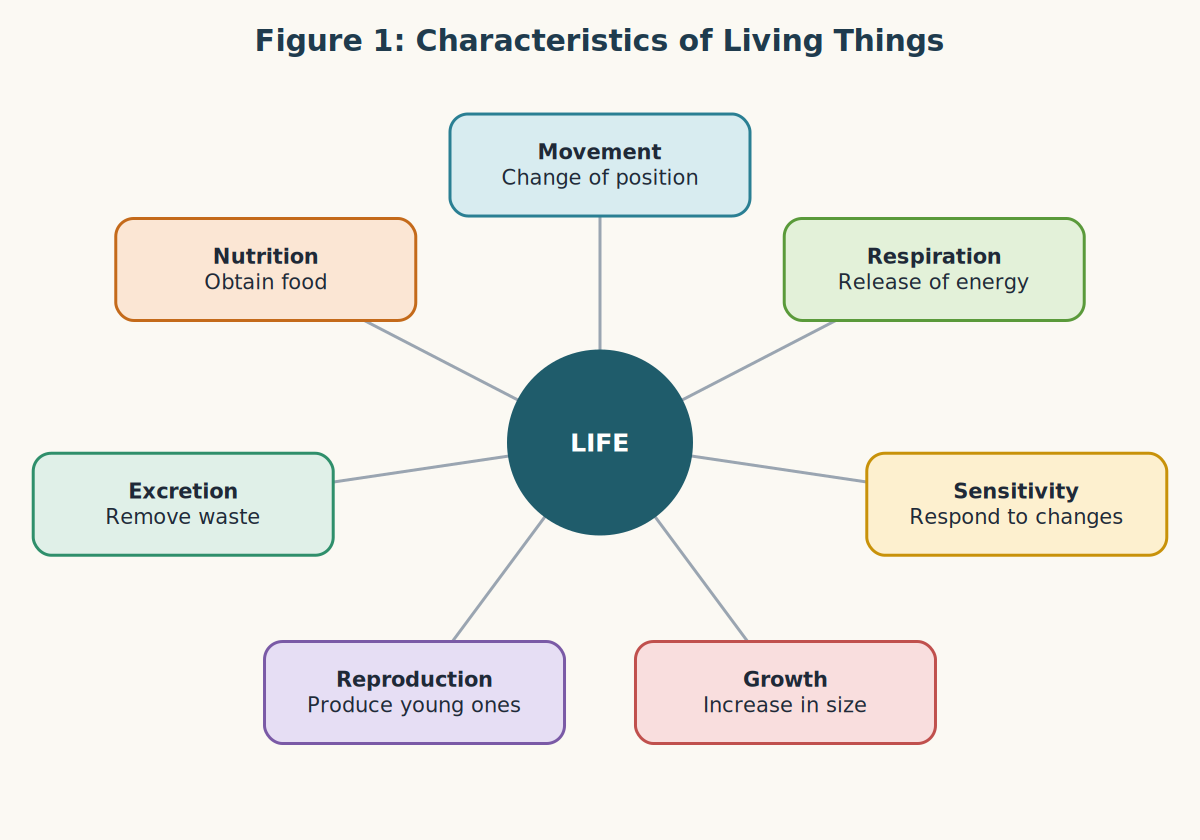
| Characteristic | Meaning | Example |
|---|---|---|
| Movement | Change of position of the whole organism or its parts. | Animals walk or swim; plants turn leaves towards light. |
| Respiration | Chemical process that releases energy from food in all living cells. | Humans breathe in oxygen for respiration. |
| Sensitivity (irritability) | Ability to detect and respond to changes in the surroundings. | Leaves of the mimosa (touch-me-not) plant fold when touched; blinking in bright light. |
| Growth | Permanent increase in size and number of cells. | A seedling becoming a tree; a child becoming an adult. |
| Reproduction | Production of new individuals of the same kind. | Hens lay eggs; plants form seeds. |
| Excretion | Removal of waste products made by the body's chemical activities. | Passing out urine, sweat and carbon dioxide. |
| Nutrition | Taking in and using food for energy, growth and repair. | Plants make food by photosynthesis; animals eat food. |
Living and non-living things
| Living things | Non-living things |
|---|---|
| Show all seven characteristics of life | Do not show these characteristics |
| Are made of cells | Are not made of cells |
| Grow from within (by cell division) | May increase in size only by adding material from outside (e.g. a heap of sand) |
| Need food, water and air | Do not need food |
| Examples: dog, maize, mushroom, bacteria | Examples: stone, water, car, fire |
TEST YOUR UNDERSTANDING
Q5. List the seven characteristics of living things.
Q6. A learner says that a motor car is alive because it moves and uses fuel. Do you agree? Explain.
Q7. Differentiate between excretion and nutrition.
Q8. Name one way in which plants show sensitivity.
3. Branches of Biology
Biology is a very wide subject, so it is divided into branches, each studying one part of the living world. The three main branches are botany, zoology and microbiology.
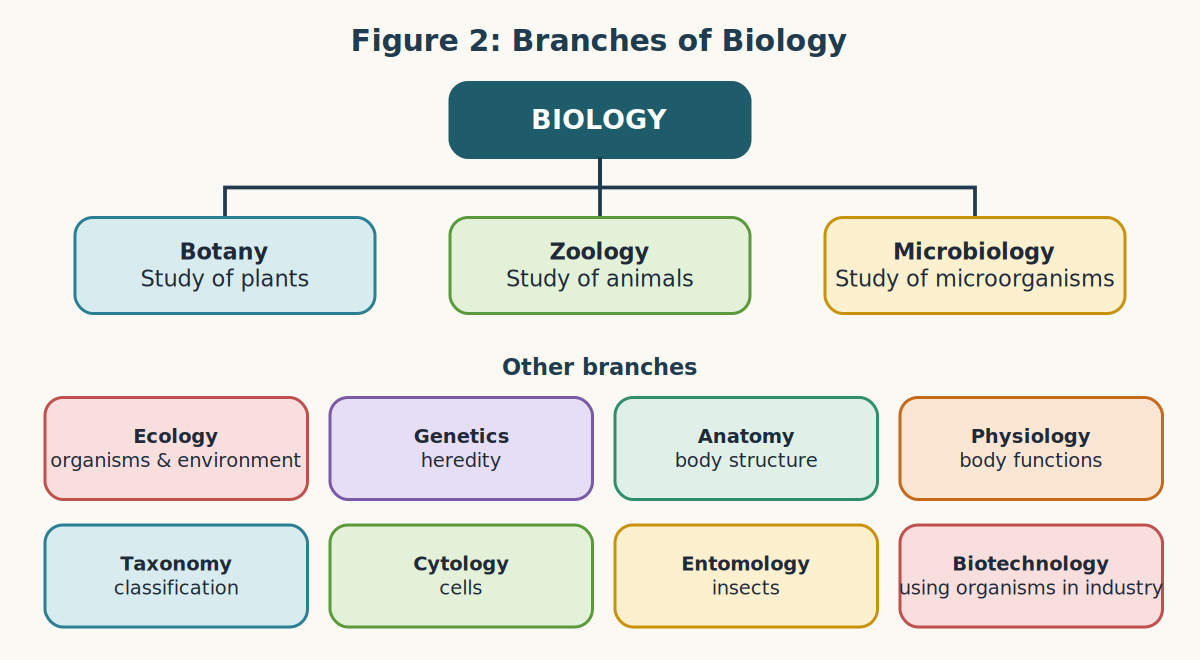
| Branch | What it studies |
|---|---|
| Botany | Plants. |
| Zoology | Animals. |
| Microbiology | Microorganisms such as bacteria, viruses and some fungi. |
| Ecology | Relationships between organisms and their environment. |
| Genetics | Heredity: how characteristics are passed from parents to offspring. |
| Anatomy (morphology) | Structure and form of organisms and their parts. |
| Physiology | Functions of the body parts and organs. |
| Taxonomy | Naming and classification of organisms. |
| Cytology | Cells. |
| Histology | Tissues. |
| Entomology | Insects. |
| Parasitology | Parasites and the diseases they cause, e.g. malaria parasites. |
| Pathology | Diseases, their causes and effects. |
| Mycology | Fungi (e.g. mushrooms, moulds). |
| Embryology | Development of an embryo, from fertilised egg to birth or hatching. |
| Biotechnology | Using living things or their products to make useful goods, e.g. yoghurt, medicines. |
| Evolution | How living things have changed over a very long time. |
TEST YOUR UNDERSTANDING
Q9. Name the three main branches of biology and say what each studies.
Q10. Which branch of biology studies: (a) heredity, (b) insects, (c) classification of organisms?
Q11. Distinguish between anatomy and physiology.
4. Importance of Studying Biology
| Area | How biology helps |
|---|---|
| Health and medicine | Helps us understand diseases (e.g. malaria, cholera, HIV and AIDS), prevent them, and develop vaccines and medicines. |
| Food and agriculture | Improves crop and livestock production through better seeds, breeds, pest and disease control and proper farming methods. |
| Environmental conservation | Teaches us to protect forests, water sources, wildlife and soil and to manage waste. |
| Understanding ourselves | Explains how our body works and how to care for it: nutrition, hygiene, growth and reproduction. |
| Careers | Prepares learners for many professions (see list below). |
| Economic development | Supports farming, fisheries, forestry, tourism, and industries such as food processing and medicines. |
| Wise decisions | Helps us make informed choices about health, family, population, diet and the environment. |
| Scientific skills | Develops observation, investigation, critical thinking and problem solving. |
Careers that need biology
Medical doctor, nurse, pharmacist, laboratory technician, nutritionist, veterinary doctor, agricultural officer, fisheries officer, forester, wildlife and park officer, environmental officer, biotechnologist, researcher and science teacher.
TEST YOUR UNDERSTANDING
Q12. Give five reasons why it is important to study biology.
Q13. Name four careers that require knowledge of biology.
5. Relationship Between Biology and Other Scientific Fields
Science fields are connected. Biology uses ideas and methods from other subjects, and other subjects use biological knowledge.
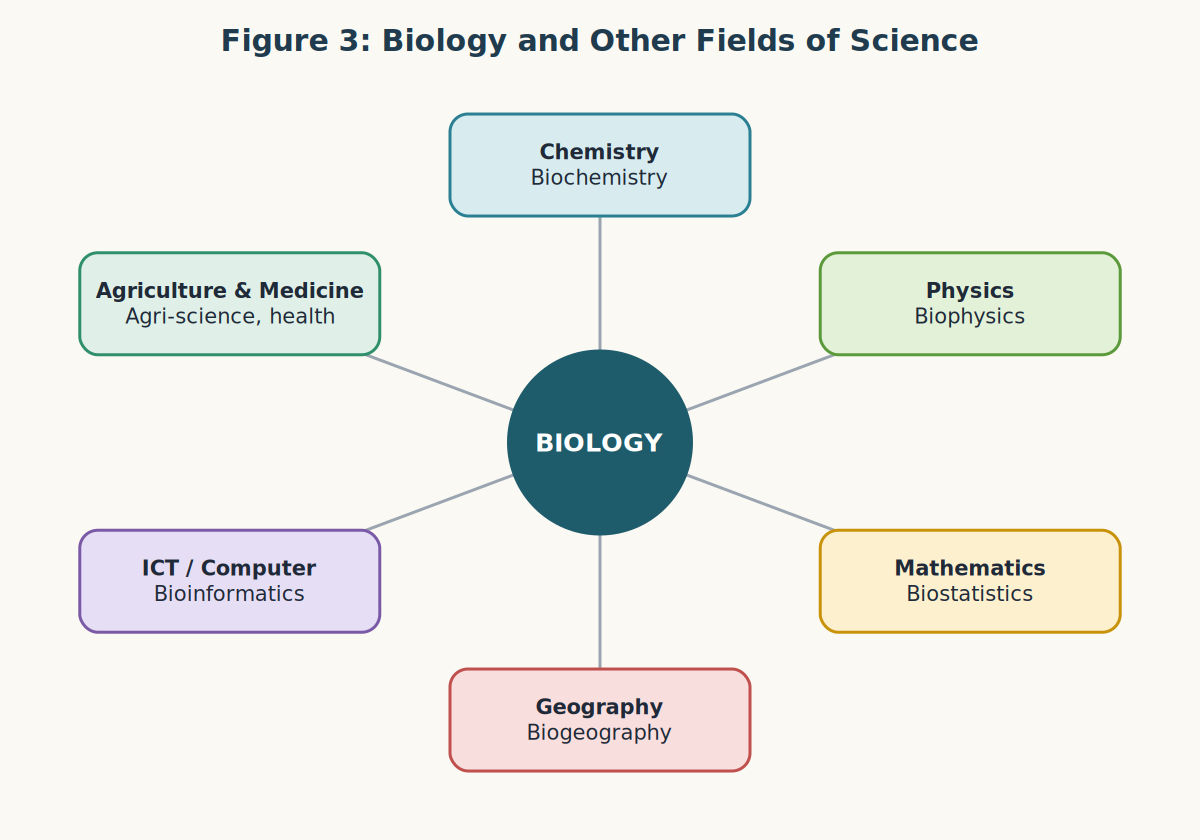
| Field | Combined field | Example of the link |
|---|---|---|
| Chemistry | Biochemistry | Photosynthesis, digestion and respiration are chemical reactions in living things. |
| Physics | Biophysics | Light and lenses in the eye; blood flow and pressure; X-rays used to see bones. |
| Mathematics | Biostatistics | Counting populations, measuring growth, calculating averages and drawing graphs of results. |
| Geography | Biogeography | Climate, soil and landforms decide which organisms live where (e.g. the distribution of forests and grasslands). |
| Agriculture | Agricultural science | Crop and livestock improvement is based on botany, zoology and genetics. |
| Medicine | Medical science | Diagnosing and treating disease needs anatomy, physiology and microbiology. |
| ICT / Computer science | Bioinformatics | Computers store and analyse biological data such as genetic information. |
| Engineering | Biomedical engineering | Artificial limbs, hearing aids and medical machines. |
TEST YOUR UNDERSTANDING
Q14. How is biology related to chemistry? Give one example.
Q15. Name the field formed by the combination of: (a) biology and physics, (b) biology and mathematics.
Q16. How can mathematics help a biologist studying the number of fish in a lake?
6. Real-Life Applications of Biology
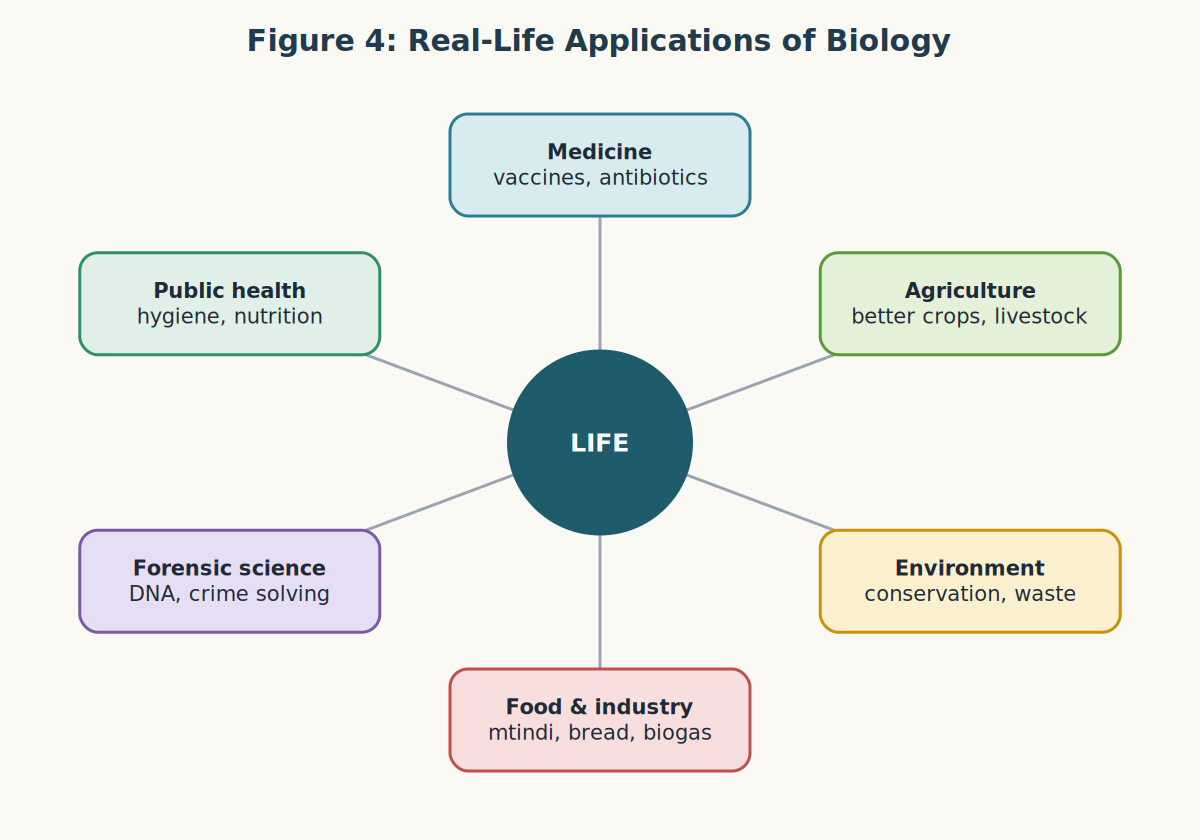
| Area | Examples of application |
|---|---|
| Medicine | Vaccines (e.g. against measles and polio), antibiotics, blood groups and safe blood transfusion, malaria control and treatment, family planning. |
| Agriculture | Improved seeds and breeds, crop rotation, control of pests and diseases, vaccination and dipping of livestock, fish farming. |
| Food and industry | Making mtindi (yoghurt), bread, cheese and vinegar using microorganisms; brewing and food preservation; biogas from animal waste; compost. |
| Environment | Conservation of forests and wildlife, tree planting, waste management and recycling, protection of water sources. |
| Public health | Hygiene, clean water, sanitation, balanced diet and health education; fighting HIV and AIDS, cholera and malaria. |
| Forensic science | DNA and fingerprints used to identify criminals and victims and to settle family disputes. |
| Biotechnology | Producing insulin, vaccines and disease-resistant crops using living cells. |
Case study: malaria control
Malaria is caused by a parasite (Plasmodium) spread by the female Anopheles mosquito. Knowledge of biology tells us how to fight it: sleep under treated mosquito nets, clear stagnant water where mosquitoes breed, use medicine as prescribed, and seek early treatment. Entomology, parasitology, ecology and medicine all work together here.
TEST YOUR UNDERSTANDING
Q17. Give three ways in which biology is applied in agriculture.
Q18. Explain how biological knowledge helps in controlling malaria.
Q19. Name two foods made with the help of microorganisms.
Chapter Summary
- Biology is the scientific study of living things (organisms).
- All living things are made of cells and show seven characteristics of life: movement, respiration, sensitivity, growth, reproduction, excretion and nutrition (MRS GREN).
- Biology has many branches. The three main ones are botany (plants), zoology (animals) and microbiology (microorganisms); others include ecology, genetics, anatomy, physiology, taxonomy and cytology.
- Studying biology helps us in health, food production, conservation, careers, economic development and wise decision making.
- Biology is linked to chemistry (biochemistry), physics (biophysics), mathematics (biostatistics), geography (biogeography), ICT (bioinformatics), agriculture and medicine.
- Biology is applied in medicine, agriculture, food and industry, environmental care, public health, forensic science and biotechnology.
Enjoying this chapter? Practice questions, progress tracking and the remaining five chapters are waiting in the app.
Continue in the appEnd-of-Topic Questions
Attempt all questions in your exercise book before checking the suggested answers.
- Section A: Multiple choice. Choose the correct answer. (i) The study of plants is called: A. Zoology B. Botany C. Ecology D. Genetics. (ii) Which is NOT a characteristic of living things? A. Growth B. Excretion C. Rusting D. Reproduction. (iii) The removal of waste products from the body is: A. Nutrition B. Excretion C. Respiration D. Growth. (iv) The study of heredity is: A. Taxonomy B. Cytology C. Genetics D. Anatomy. (v) Biophysics results from combining biology with: A. Chemistry B. Physics C. Geography D. Mathematics. (5 marks)
- Match the items in Column A with those in Column B: (i) Entomology (ii) Cytology (iii) Microbiology (iv) Taxonomy (v) Ecology. Column B: A. Cells B. Classification C. Insects D. Microorganisms E. Organisms and their environment. (5 marks)
- (a) Define biology. (b) Name the seven characteristics of living things. (9 marks)
- Outline any five differences between living and non-living things. (5 marks)
- State the meaning of the following terms: (a) organism, (b) habitat, (c) species, (d) hypothesis. (4 marks)
- Briefly explain five reasons for studying biology. (10 marks)
- Explain how biology is related to: (a) chemistry, (b) mathematics, (c) geography. (6 marks)
- Describe four real-life applications of biology in your community. (8 marks)
- A farmer notices that maize near a river grows taller than maize on dry land. Using the scientific method, suggest how you would investigate the cause. (6 marks)
Suggested Answers
- (i) B. Botany. (ii) C. Rusting. (iii) B. Excretion. (iv) C. Genetics. (v) B. Physics.
- (i) C. (ii) A. (iii) D. (iv) B. (v) E.
- (a) The scientific study of living things. (b) Movement, respiration, sensitivity, growth, reproduction, excretion, nutrition.
- Living things show all seven characteristics, are made of cells, grow from within, need food, water and air, and reproduce; non-living things do not show these.
- (a) A living thing. (b) The place where an organism lives. (c) A group of organisms of the same kind that can reproduce to give fertile offspring. (d) An educated guess that can be tested.
- Prevent and treat diseases; improve food production; conserve the environment; understand how our bodies work and how to take care of them; prepare for careers; develop the economy; make informed decisions (any five, each explained).
- (a) Chemistry: biochemistry, as digestion and photosynthesis are chemical reactions. (b) Mathematics: biostatistics, as counting, averages and graphs help analyse data. (c) Geography: biogeography, as climate and landforms affect where organisms live.
- Examples: vaccination and malaria control (medicine); improved seeds and livestock dipping (agriculture); making mtindi or bread (food and microorganisms); tree planting and conservation (environment); hygiene and clean water (public health). Each application should be described.
- Observation: taller maize near the river. Question: does water cause the difference? Hypothesis: maize with more water grows taller. Experiment: grow maize in two plots, giving one more water, keeping all other conditions (soil, seed, light) equal. Results: measure height weekly and record. Conclusion: accept or reject the hypothesis from the data.
These are suggested answers. Credit is also given to correct points expressed in your own words.
Ready for Chapter 2: Scientific Processes in Biology?
Continue Form One Biology in the Click Online Academy app, with all six chapters in your pocket.
Click here to continue learning on our app