CHAPTER ONE: COORDINATE GEOMETRY
Form 4 Mathematics • Comprehensive Notes
All Form Four Mathematics topics
Read Topic 1 free on this page. The other 7 topics are ready in the Click Online Academy app.
- Topic 1Coordinate GeometryFree preview below
- Topic 2Areas and PerimeterIn the app
- Topic 3Three Dimensional FiguresIn the app
- Topic 4ProbabilityIn the app
- Topic 5TrigonometryIn the app
- Topic 6VectorsIn the app
- Topic 7Matrices and TransformationsIn the app
- Topic 8Linear ProgrammingIn the app
Chapter Objectives
By the end of this chapter, you should be able to:
- Derive the general equation of a straight line.
- Determine the coordinates of the mid-point of a line segment.
- Calculate the distance between two points on the xy-plane.
- Determine the conditions for both parallel and perpendicular lines.
- Solve problems involving parallel and perpendicular lines.
- Solve problems on parallel and perpendicular lines in real-life situations.
Key Terms and Concepts
1. Equation of a Straight Line
Consider two points $(2, 1)$ and $(2, 3)$ as shown below.
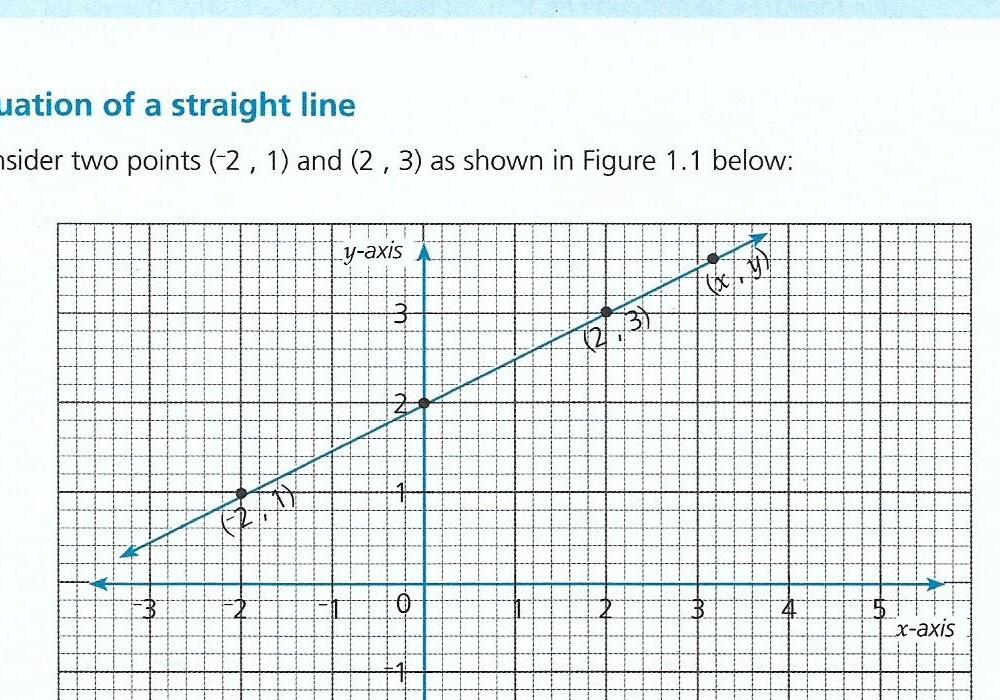
The gradient $m$ of the line through these points is:
If $(x, y)$ is another point on the line, the gradient is also $\dfrac{y-3}{x-2}$. Since the gradient is constant:
In general, if a line has gradient $m$ and y-intercept $c$, its equation is:
General Derivation (Two-Point Form)
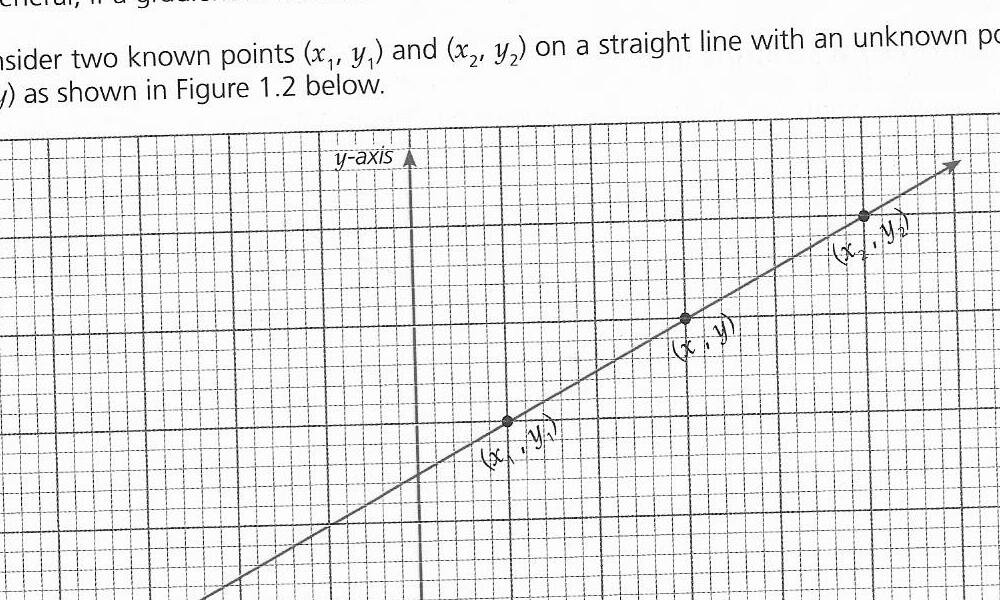
For two known points $(x_1, y_1)$ and $(x_2, y_2)$ and an unknown point $(x, y)$ on the line:
Cross-multiplying and rearranging leads to the standard form:
SPOTLIGHT
Did you know? The slope-intercept form $y = mx + c$ is one of the most used equations in real life — from predicting stock prices and modelling population growth to designing roads and ski slopes! The gradient $m$ tells engineers how steep a ramp or roof should be.
Worked Examples
Find the equation of a straight line which passes through $(2, 3)$ and whose slope is $\dfrac{2}{3}$.
Solution:
Using $m = \dfrac{y - y_1}{x - x_1}$:
Alternatively using $y = mx + c$: $3 = \dfrac{2}{3}(2) + c \implies c = \dfrac{5}{3}$.
∴ Equation is $y = \dfrac{2}{3}x + \dfrac{5}{3}$.
Find the equation of a straight line passing through the points $(0, -1)$ and $(2, 4)$ in the form $ax + by + c = 0$.
Solution:
Find the equation of a straight line passing through $(5, 8)$ and having the same y-intercept as the line $2x - y = 5$. Write it in standard form.
Solution:
From $2x - y = 5$, when $x=0$: $y = -5$. So y-intercept is $-5$.
Line passes through $(0, -5)$ and $(5, 8)$:
Find the equation of a straight line with gradient $\dfrac{3}{2}$ and y-intercept $5$ in the form $ax + by + c = 0$.
Solution:
Find the equation of a straight line with x-intercept $2$ and y-intercept $-5$.
Solution: Passes through $(2, 0)$ and $(0, -5)$.
Jog your Brain – Equation of a Straight Line
Test yourself! Click to reveal answers after attempting.
Q1. Find the equation of a straight line joining the points $(3, 6)$ and $(2, 4)$ in the form $y = mx + c$.
Q2. Find the equation of a straight line passing through $(0, 2)$ with gradient $2$.
Q3. Calculate the equation of a straight line passing through $(2, -4)$ which has the same slope as the line $3x - 6y + 12 = 0$.
Q4. Find the equation of a straight line with slope $\dfrac{1}{3}$ having the same y-intercept as $2x - 5y + 10 = 0$.
Q5. Find the equation of a straight line through $(5, 0)$ with infinite gradient.
Q6. Find the equation of a straight line through $(0, 4)$ with gradient zero.
Mid-point of a Line Segment
The mid-point $M$ of a line segment $AB$ is the point which divides the segment into two equal halves. Thus $\overline{AM} = \overline{MB}$.
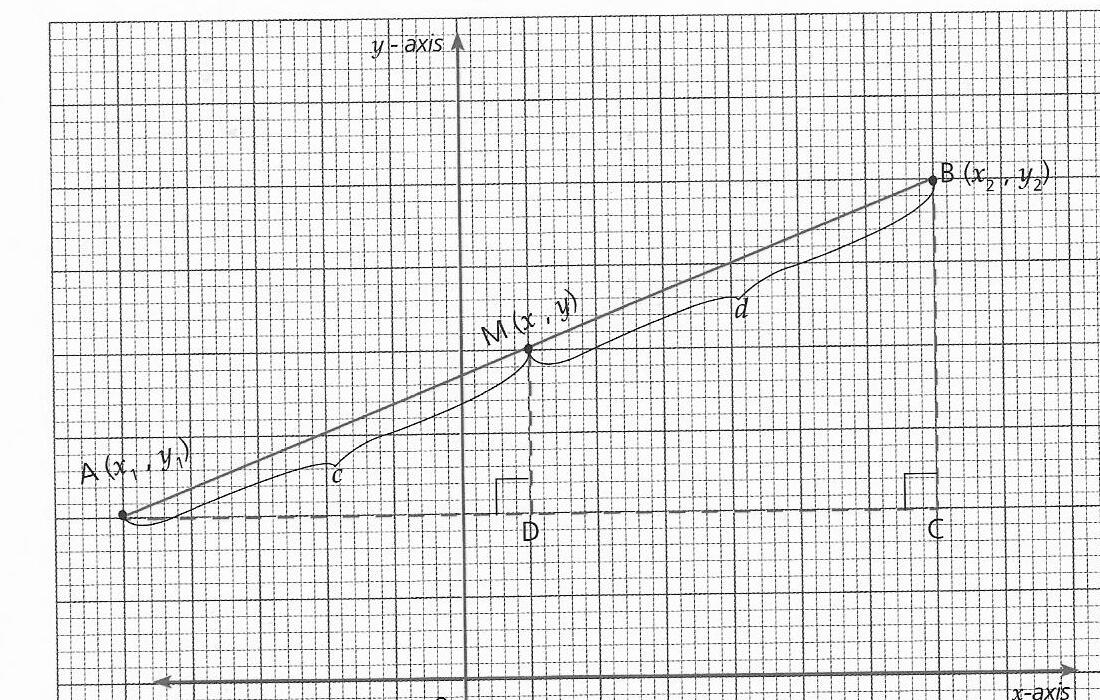
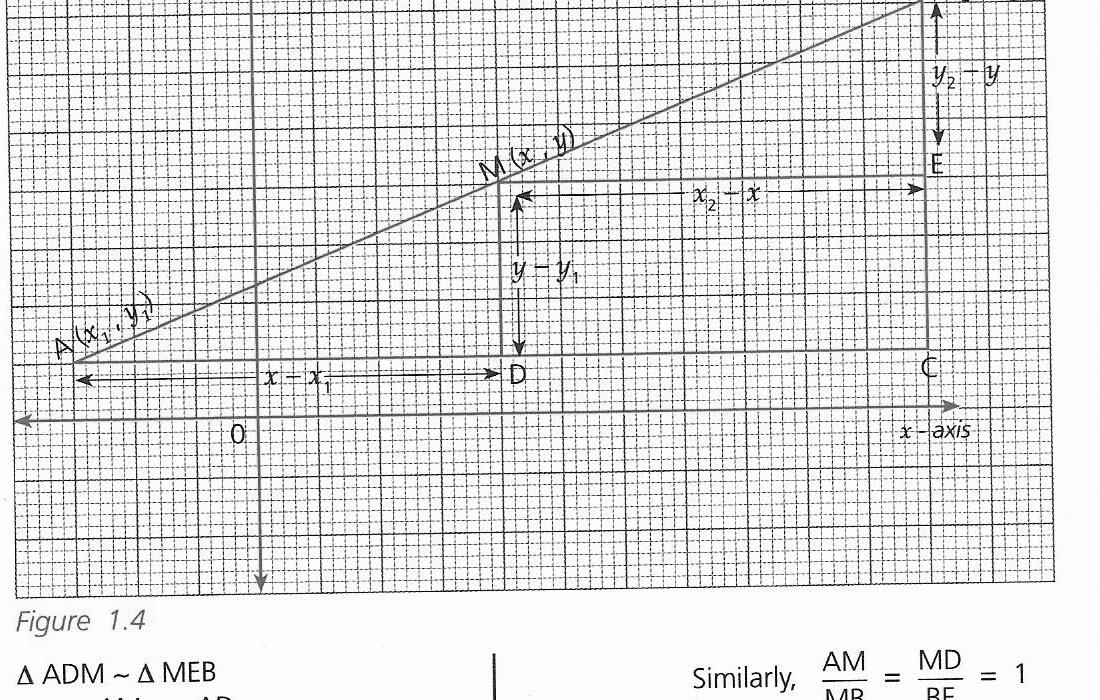
Using similar triangles (or section formula with ratio $1:1$), the coordinates of the mid-point $M(x, y)$ are:
SPOTLIGHT
In a parallelogram, the diagonals bisect each other — their mid-points coincide! This is a powerful way to prove a quadrilateral is a parallelogram using coordinate geometry.
Worked Examples
Find the mid-point of the line segments whose end points are:
(a) $A(8, -2)$ and $B(-4, 3)$
(b) $A(1, 4)$ and $B(3, 6)$
(c) $A(a + 2b, 2a - b)$ and $B(b - 3a, -3b)$
Solution:
(a) $M = \left( \dfrac{8 + (-4)}{2}, \dfrac{-2 + 3}{2} \right) = (2, \dfrac{1}{2})$
(b) $M = \left( \dfrac{1+3}{2}, \dfrac{4+6}{2} \right) = (2, 5)$
(c) $M = \left( \dfrac{a+2b + b-3a}{2}, \dfrac{2a-b + (-3b)}{2} \right) = \left( \dfrac{-2a + 3b}{2}, a - 2b \right)$ or $(1.5b - a, a - 2b)$
$M$ is the mid-point of $AB$. If $M(2, 3)$ and $B(-1, 2)$, find the coordinates of $A$.
Solution: Let $A(x_2, y_2)$.
∴ $A(5, 4)$.
A parallelogram has vertices $A(1, 7)$, $B(6, 4)$, $C(3, 1)$ and $D(-2, 4)$.
(a) Find the coordinates of the mid-points of the diagonals.
(b) Show that the diagonals bisect each other.
Solution:
Mid-point of $DB$: $\left( \dfrac{6 + (-2)}{2}, \dfrac{4+4}{2} \right) = (2, 4)$
Mid-point of $AC$: $\left( \dfrac{1+3}{2}, \dfrac{7+1}{2} \right) = (2, 4)$
Since both mid-points are the same, the diagonals bisect each other.
Jog your Brain – Mid-point
Q1. Find the mid-point of $(-3, 4)$ and $(4, -4)$.
Q2. $M$ is the mid-point of $AB$. $M(2, 1)$ and $A(-3, 1)$. Find coordinates of $B$.
Q3. Show that the mid-point of $(\sqrt{12}, \sqrt{8})$ and $(4\sqrt{3}, 4\sqrt{2})$ is $(3\sqrt{3}, 3\sqrt{2})$.
Distance Between Two Points on a Plane
Consider two points $A(x_1, y_1)$ and $B(x_2, y_2)$. Draw a right-angled triangle with hypotenuse $AB$.
By Pythagoras’ Theorem:
SPOTLIGHT
The distance formula is simply the Pythagorean theorem in disguise! It is used in GPS systems, computer graphics, robotics path planning, and even in measuring the “distance” between data points in machine learning.
Worked Examples
Find the distance between $A(-1, -1)$ and $B(2, 3)$.
Solution:
Distance is $5$ units.
The distance between $P(k, 2)$ and $Q(-3, 5)$ is $5$. Find the possible values of $k$.
Solution:
Jog your Brain – Distance
Q1. Find the distance between $(-2, -3)$ and $(4, 5)$.
Q2. Prove that the triangle with vertices $A(1, -1)$, $B(4, -1)$, $C(1, 3)$ is right-angled.
Q3. Find the distance of the point $(8, 6)$ from the origin.
Enjoying this topic? Your progress, practice questions and the remaining 7 topics are waiting in the app.
Continue in the app2. Parallel Lines
Two or more lines which do not meet (no matter how far extended) and maintain a constant distance between them are called parallel lines. Railway tracks are a classic real-life example.
From similar triangles, it follows that parallel lines have equal slopes:
SPOTLIGHT
In architecture and civil engineering, parallel lines ensure that walls, railway tracks, and power lines remain evenly spaced and structurally sound. Even the lanes on a highway rely on the concept of parallel lines!
Find the equation of a straight line passing through the origin and parallel to the line $4x - 3y - 2 = 0$. Write it in the form $ax + by + c = 0$.
Solution:
Rewrite: $y = \dfrac{4}{3}x - \dfrac{2}{3}$, so $m_1 = \dfrac{4}{3}$.
Since parallel, $m_2 = \dfrac{4}{3}$. Through $(0,0)$:
Jog your Brain – Parallel Lines
Q1. Find the equation of a straight line passing through $(3, 4)$ and parallel to $12x + 6y = 9$.
Q2. Show that $3x - y + 6 = 0$ is parallel to $6x - 2y + 7 = 0$.
Q3. The line through $A(k, 4)$ and $B(3, 2k)$ is parallel to $y + 3x - 4 = 0$. Find $k$.
3. Perpendicular Lines
Two lines are perpendicular (normal) if they meet at a right angle ($90^\circ$).
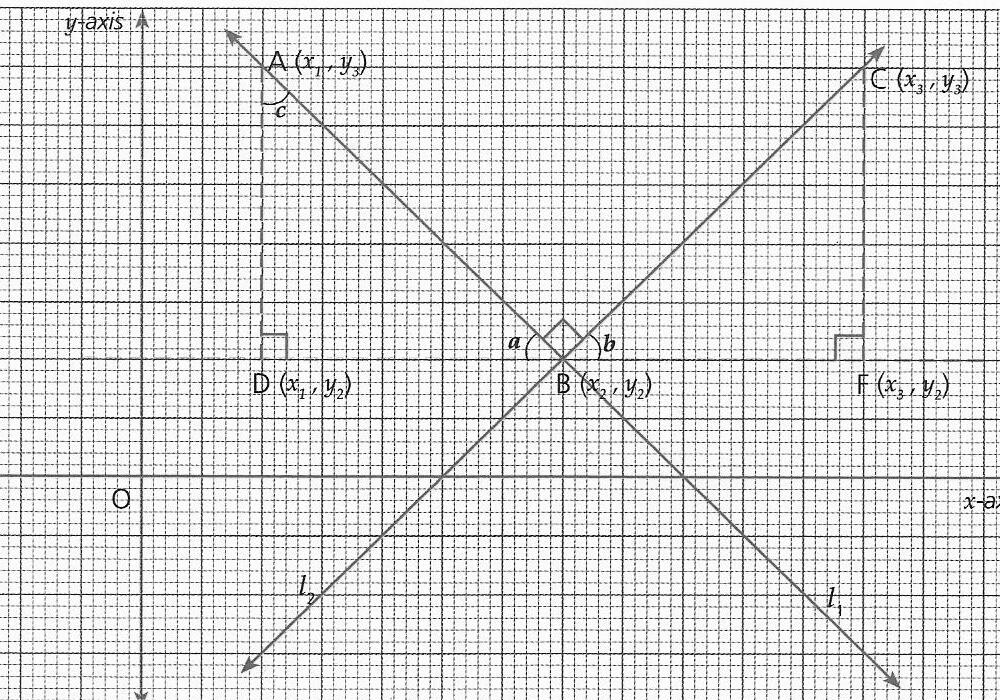
Using similar triangles and complementary angles, the condition is:
SPOTLIGHT
Perpendicular lines are everywhere: the corners of a book, the intersection of latitude and longitude lines on a map (approximately), and the axes of a coordinate system itself. In design, right angles create stability and balance.
Find the equation of a straight line passing through $(-4, 2)$ and perpendicular to $x + 2y = 4$.
Solution:
$x + 2y = 4 \implies y = -\dfrac{1}{2}x + 2$, so $m_1 = -\dfrac{1}{2}$.
Thus $m_2 = 2$. Through $(-4, 2)$:
Find the equation of the perpendicular bisector of the line segment joining $A(9, 1)$ and $B(7, -5)$.
Solution:
Mid-point: $\left( \dfrac{9+7}{2}, \dfrac{1+(-5)}{2} \right) = (8, -2)$
Slope of $AB$: $\dfrac{1-(-5)}{9-7} = 3$. Therefore perpendicular slope $= -\dfrac{1}{3}$.
Jog your Brain – Perpendicular Lines
Q1. Find the equation of the perpendicular bisector of the segment joining $(0, 2)$ and $(3, 6)$.
Q2. Find the equation of a straight line passing through $(3, -2)$ and perpendicular to the line through $(-4, 3)$ and $(2, 6)$.
Chapter Summary
- The gradient (slope) of a line through $(x_1,y_1)$ and $(x_2,y_2)$ is $m = \dfrac{y_2-y_1}{x_2-x_1}$.
- Equation of a line: $y = mx + c$ (slope-intercept form) or $ax + by + c = 0$ (standard form).
- Mid-point of a segment joining $(x_1,y_1)$ and $(x_2,y_2)$ is $\left( \dfrac{x_1+x_2}{2}, \dfrac{y_1+y_2}{2} \right)$.
- Distance between two points: $d = \sqrt{(x_2-x_1)^2 + (y_2-y_1)^2}$.
- Parallel lines have equal gradients: $m_1 = m_2$.
- Perpendicular lines satisfy $m_1 m_2 = -1$.
- These concepts are used to solve real-life problems involving roads, railways, architecture, navigation, and more.
Suggested Answers (Selected Exercises)
Exercise 1.1 (Equation of Straight Lines)
Exercise 1.2 / Mid-point Questions
Exercise 1.3 (Distance)
Parallel Lines
Perpendicular Lines
Ready for Topic 2: Areas and Perimeter?
Continue Form Four Mathematics in the Click Online Academy app, with all 8 topics in your pocket.
Click here to continue learning on our app