Topics All Form Four Physics topics
Read Topic 1 free on this page. The other 6 topics are ready in the Click Online Academy app.
- Topic 1WavesFree preview below
- Topic 2ElectromagnetismIn the app
- Topic 3RadioactivityIn the app
- Topic 4Thermal EmissionsIn the app
- Topic 5ElectrostaticsIn the app
- Topic 6Elementary AstronomyIn the app
- Topic 7GeophysicsIn the app
Section 1Key terms and concepts
Master these definitions. NECTA frequently awards full marks for precise wording of key terms.
- Wave
- A periodically repeating disturbance that travels through a medium (or space) from one location to another, without net movement of the medium or its particles.
- Crest
- The point of maximum positive displacement of the medium particles from the equilibrium position.
- Trough
- The point of maximum negative displacement of the medium particles from the equilibrium (still) position.
- Amplitude (A)
- The maximum displacement of the medium particles from the equilibrium position. SI unit: metre (m).
- Wavelength (λ)
- The distance between two successive crests or two adjacent troughs (or the distance the wave travels in one complete cycle). SI unit: metre (m).
- Period (T)
- The time taken for the wave to complete one cycle (crest to next crest or trough to next trough). SI unit: second (s). T = t/n.
- Frequency (f)
- The number of complete wave cycles that pass a fixed point in one second. SI unit: hertz (Hz). f = 1/T.
- Wave velocity (v)
- The speed at which the wave travels through the medium. SI unit: m s−1. v = fλ.
- Mechanical wave
- A wave that requires a material medium (solid, liquid or gas) for its propagation. Examples: sound, water waves, waves on a string.
- Electromagnetic wave
- A wave produced by oscillating electric and magnetic fields that can travel through vacuum at 3 × 10⁸ m s−1. Examples: light, radio waves, X-rays.
- Transverse wave
- A wave in which particles of the medium vibrate perpendicular to the direction of wave propagation.
- Longitudinal wave
- A wave in which particles of the medium vibrate parallel to the direction of wave propagation. Consists of compressions and rarefactions.
- Compression
- A region of high pressure and high density in a longitudinal wave where particles are pushed close together.
- Rarefaction
- A region of low pressure and low density in a longitudinal wave where particles are spread further apart.
- Reflection
- The bouncing back of a wave when it meets a boundary that does not allow it to pass through.
- Refraction
- The change in direction (and speed) of a wave when it travels from one medium into another of different properties.
- Interference
- The combination of two or more waves to form a resultant wave in which particle displacement is reinforced (constructive) or cancelled (destructive).
- Diffraction
- The spreading out (or apparent bending) of waves when they pass through a narrow aperture or around an obstacle.
- Resonance
- The large-amplitude oscillation that occurs when a system is driven at its natural frequency.
- Beat
- The periodic variation in loudness heard when two notes of nearly equal frequency are sounded together.
Section 2Concept of a wave
If you drop a stone into a pond of still water, a disturbance (ripples) spreads outward in a circular pattern. The energy of the stone is transferred to the water molecules at the point of contact. Those molecules vibrate up and down, disturbing neighbouring molecules. The disturbance moves outward, but the water molecules themselves do not travel with it — only the energy does.
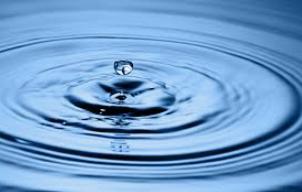
The same idea applies when you shake one end of a rope up and down: the disturbance travels along the rope while each piece of rope mainly moves up and down.
Energy travels — matter stays put
Think of a “Mexican wave” in a stadium: each spectator stands and sits, yet the wave travels around the stadium. The people stay in their seats; only the pattern moves. That is exactly how a wave works.
Section 3Wave terminologies and parameters
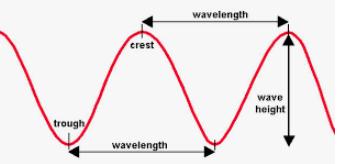
The important features of a wave are best seen on a displacement–distance graph (wave profile).
Crest and Trough
- Crest — point of maximum positive displacement from equilibrium.
- Trough — point of maximum negative displacement from equilibrium.
Amplitude (A)
The maximum displacement of particles from the equilibrium position. It is measured from the central line to the top of a crest (or bottom of a trough). SI unit: metre (m).
Wavelength (λ)
The distance between two successive crests or two successive troughs. It is also the distance the wave travels in one complete cycle. SI unit: metre (m).
Period (T)
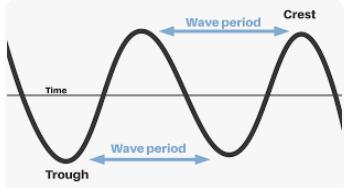
The time taken to complete one cycle (crest → next crest). SI unit: second (s).
where t is the total time and n is the number of complete cycles.
Frequency (f)
The number of complete cycles that pass a fixed point in one second. SI unit: hertz (Hz) (1 Hz = 1 cycle per second).
Wave velocity (v)
The distance travelled by the wave per unit time. SI unit: m s−1.
Phase (φ)
An angle-like quantity that represents the fraction of a cycle completed at a given time.
Section 4Relationship between wave parameters
In one period T the wave travels a distance equal to one wavelength λ. Therefore:
But f = 1/T, so the fundamental wave equation is:
Worked Example 1
Determine the amplitude, period and frequency of a wave whose displacement–time graph shows a maximum displacement of 0.5 m and one complete cycle taking 0.2 s.
Solution
- Amplitude A = 0.5 m
- Period T = 0.2 s
- Frequency f = 1/T = 1/0.2 = 5 Hz
Worked Example 2
The corresponding displacement–distance graph shows wavelength = 2 m. Find the velocity of the wave.
Solution
Worked Example 3
What is the wavelength of a wave whose speed is 4 m s−1 and frequency is 2 Hz?
Solution
Jog your Brain — Wave parameters
1. A wave has frequency 50 Hz and wavelength 4 m. Calculate its speed.
View answer
2. The period of a wave is 0.025 s. Find its frequency.
View answer
3. A radio wave has frequency 100 MHz and travels at 3 × 10⁸ m s−1. What is its wavelength?
View answer
f = 100 × 106 = 108 Hz
Section 5Propagation of waves
Wave propagation is the movement of waves in space and time.
- Mechanical waves require a material medium. Examples: sound, water waves, waves on strings. Their propagation depends on the elastic and inertial properties of the medium.
- Electromagnetic waves do not require a medium. They are produced by oscillating electric and magnetic fields that are perpendicular to each other and to the direction of propagation. They travel through vacuum at 3 × 10⁸ m s−1. Examples: visible light, radio waves, microwaves, X-rays, gamma rays.
Light from the Sun
Sunlight takes about 8 minutes 20 seconds to reach Earth — a journey of 150 million kilometres through the vacuum of space. Only electromagnetic waves can do that; sound would be silent in space.
Section 6Modes of wave propagation
Transverse waves
Particles of the medium vibrate perpendicular to the direction of wave travel. Examples: waves on a string, electromagnetic waves, (approximately) water surface waves.

Longitudinal waves
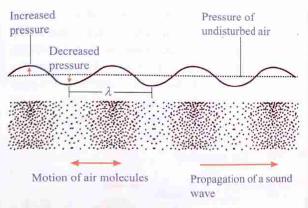
Particles vibrate parallel to the direction of wave travel. The wave consists of alternating compressions (high pressure/density) and rarefactions (low pressure/density). The wavelength is the distance between centres of two successive compressions (or rarefactions). Example: sound waves.
Section 7Behaviour of waves
In a uniform medium a wave travels at constant speed. When the properties of the medium change, the wave speed (and therefore wavelength) changes while frequency stays the same. The main behaviours are reflection, refraction, diffraction and interference.
Section 8Reflection of waves
When a wave meets a boundary that does not allow it to pass, it bounces back — this is reflection.
- Fixed end (string tied to a rigid wall): the reflected pulse is inverted.
- Free end (string tied to a sliding ring): the reflected pulse is not inverted but has reduced amplitude (some energy is lost).
Applications of reflection
- Design of mirrors (reflection of light).
- Sonar systems (reflection of sound underwater to measure distance and speed of objects).
- Hearing aids and stethoscopes (multiple reflections concentrate sound).
- Soundboards in auditoriums (uniform reflection improves sound quality).
Bats and sonar
Bats emit high-frequency sound pulses and listen for the echoes. From the time delay and frequency shift they build a detailed “sound picture” of their surroundings — nature’s own sonar system.
Section 9Refraction of waves
Refraction is the change in direction of a wave when it passes from one medium into another of different properties. The change in speed causes a change in wavelength; frequency remains constant.
For water waves: speed is higher in deep water than in shallow water, so wavelength is longer in deep water.
Water waves obey Snell’s law:
Worked Example
Speed of light in water = 2.25 × 10⁸ m s−1; in air = 3 × 10⁸ m s−1.
(a) Refractive index of water relative to air:
(b) If i = 30°, then sin r = sin 30° / 1.33 ≈ 0.376 → r ≈ 22.1°.
Applications of refraction
- Lenses in cameras, microscopes, telescopes and spectacles.
- Identification of purity of materials by measuring refractive index.
Section 10Interference of waves
When two or more waves meet in the same medium they superpose. The principle of superposition states that the resultant displacement at any point is the algebraic sum of the individual displacements.
- Constructive interference — crest meets crest (or trough meets trough) → larger amplitude.
- Destructive interference — crest meets trough → smaller or zero amplitude.
Interference is responsible for the coloured patterns in soap bubbles and oil films, and is used in noise-cancelling headphones.
Section 11Diffraction of waves
Diffraction is the spreading of waves when they pass through a narrow gap or around an obstacle. The effect is most noticeable when the size of the gap is comparable to the wavelength.
Applications
- Holography (three-dimensional images).
- X-ray diffraction for determining atomic spacing in crystals.
- Measuring thickness of thin films and crystallite size.
Enjoying this topic? Your progress, practice questions and the remaining 6 topics are waiting in the app.
Continue in the appSection 12Sound waves
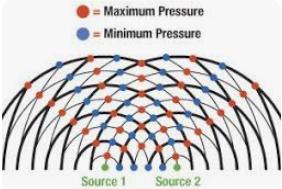
Sound is a mechanical longitudinal wave produced by vibrating objects and transmitted through a medium (solid, liquid or gas) as pressure variations (compressions and rarefactions).
Speed of sound
Sound travels fastest in solids (particles closest together) and slowest in gases. Speed increases with temperature.
Characteristics of sound
- Pitch — determined by frequency (higher frequency → higher pitch).
- Loudness — determined by amplitude (larger amplitude → louder sound).
- Quality (timbre) — determined by the mixture of overtones; allows us to distinguish different instruments playing the same note.
Section 13Echo and reverberation
An echo is a reflected sound wave that is heard distinctly after the original sound. For a clear echo the reflecting surface must be at least about 17 m away (so that the time delay ≥ 0.1 s).
where t is the time between the original sound and the echo.
Reverberation is the persistence of sound due to multiple reflections in an enclosed space. Excessive reverberation reduces speech clarity; controlled reverberation improves music in concert halls.
Section 14Musical sounds and instruments
Musical instruments are grouped into three categories:
- String instruments (guitar, violin, piano) — vibrating strings.
- Wind instruments (flute, trumpet, organ) — vibrating columns of air.
- Percussion instruments (drum, cymbals, xylophone) — vibrating membranes or bars.
Section 15Stationary (standing) waves
A stationary wave is formed when two progressive waves of the same frequency, amplitude and speed travel in opposite directions and interfere. The resulting pattern has fixed points of zero displacement (nodes) and points of maximum displacement (antinodes).
On a string fixed at both ends the allowed wavelengths are:
and the frequencies (harmonics) are:
where T is tension and μ is linear mass density.
Section 16Resonance
Resonance occurs when a system is driven at its natural frequency, producing a large-amplitude response.
Closed pipe (one end closed)
Fundamental: L = λ/4 → f1 = v/(4L)
Odd harmonics only: f3 = 3v/(4L), f5 = 5v/(4L), …
Open pipe (both ends open)
Fundamental: L = λ/2 → f1 = v/(2L)
All harmonics: fn = n v/(2L)
Section 17Beats
When two notes of slightly different frequencies f1 and f2 are sounded together, the loudness rises and falls periodically. The number of beats per second (beat frequency) is:
Beats are used by musicians to tune instruments: when the beat frequency falls to zero the two notes are in unison.
Section 18Chapter summary
Key take-aways
- A wave is a disturbance that transfers energy without net transport of matter.
- Mechanical waves need a medium; electromagnetic waves do not.
- Transverse → particles vibrate perpendicular to propagation; longitudinal → parallel (compressions & rarefactions).
- Key parameters: amplitude A, wavelength λ, period T, frequency f, speed v = fλ.
- Waves undergo reflection, refraction, diffraction and interference.
- Sound is a longitudinal pressure wave; pitch ↔ frequency, loudness ↔ amplitude, quality ↔ overtones.
- Stationary waves form by interference of two opposite progressive waves; nodes and antinodes appear.
- Resonance produces large amplitude when driving frequency equals natural frequency.
- Beats: fbeat = |f1 − f2|.
Section 19End of topic questions
Multiple-choice and structured questions
1. How does a transverse wave propagate in a medium?
(a) Along the same direction as the particle vibrations.
(b) Perpendicular to the direction of the particle vibrations.
(c) At 45° to the particle vibrations.
(d) In a circular path.
2. Which of the following is an electromagnetic wave?
(a) Sound (b) Water wave (c) Infrared radiation (d) Wave on a string
3. A wave of frequency 50 Hz travels at 20 m s−1. Its wavelength is
(a) 0.4 m (b) 2.5 m (c) 1000 m (d) 0.025 m
4. State the principle of superposition of waves.
5. Distinguish between a progressive wave and a stationary wave.
6. A rope of length 80 cm and mass 10 g is under tension 20 N. Find the frequencies of the 1st and 3rd harmonics.
7. Explain why soldiers are advised not to march in step across a bridge.
8. In a resonance-tube experiment the first resonance occurs at 9.0 cm. How far must the tube be raised to hear the next peak? (Neglect end correction.)
9. The frequency of a plucked string is 400 Hz when the tension is 2 N. Calculate (i) the frequency when tension becomes 8 N; (ii) the tension needed for a frequency of 600 Hz.
10. Define (i) resonance (ii) overtones. Why do notes of the same pitch played on a violin and a flute sound different?
Section 20Suggested answers
Answers to end-of-topic questions
1.
Show answer
(b) Perpendicular to the direction of the particle vibrations.
2.
Show answer
(c) Infrared radiation (electromagnetic).
3.
Show answer
4.
Show answer
The resultant displacement at any point is the algebraic sum of the displacements due to the individual waves at that point.
5.
Show answer
A progressive wave transfers energy from one place to another; particles oscillate about their mean positions and the waveform advances. A stationary wave is formed by interference of two opposite progressive waves; energy is not transferred along the medium; nodes and antinodes are fixed in position.
6.
Show answer
L = 0.80 m, m = 0.010 kg → μ = m/L = 0.0125 kg m−1
v = √(T/μ) = √(20/0.0125) = √1600 = 40 m s−1
f1 = v/(2L) = 40/(1.6) = 25 Hz
f3 = 3 × 25 = 75 Hz
7.
Show answer
The rhythmic marching may match the natural frequency of the bridge, causing resonance and dangerously large oscillations that could damage or collapse the bridge.
8.
Show answer
First resonance (closed pipe): L1 = λ/4 = 9.0 cm → λ = 36 cm.
Next resonance: L2 = 3λ/4 = 27 cm.
The tube must be raised by 27 − 9 = 18 cm.
9.
Show answer
f ∝ √T (length and μ constant).
(i) f2 / f1 = √(T2/T1) → f2 = 400 × √(8/2) = 400 × 2 = 800 Hz
(ii) T2 / T1 = (f2/f1)2 → T2 = 2 × (600/400)2 = 2 × 2.25 = 4.5 N
10.
Show answer
(i) Resonance — large-amplitude oscillation when a system is driven at its natural frequency.
(ii) Overtones — frequencies higher than the fundamental that are present in a complex sound.
Notes of the same pitch sound different because the instruments produce different mixtures (intensities) of overtones; this is called quality or timbre.
Ready for Topic 2: Electromagnetism?
Continue Form Four Physics in the Click Online Academy app, with all 7 topics in your pocket.
Click here to continue learning on our appClick Online Academy · Physics Form Four · Chapter One: Waves
Prepared for TIE / NECTA candidates. Tap the Contents button at any time to move between sections. Pale background for easy printing.