All Form Two Geography Chapters
- Chapter 1The Internal Structure of the EarthRead below · Free
- Chapter 2The External Structure of the EarthContinue in the app
- Chapter 3Map Reading and InterpretationContinue in the app
- Chapter 4Photography Reading and InterpretationContinue in the app
CHAPTER ONE
The Internal Structure of the Earth
1. Introduction
- The Earth is the third planet in the solar system after Mercury and Venus.
- It is the only planet known where life exists in abundance.
- This chapter examines the Earth’s internal structure, the forces that operate within it, and the resulting movements and landforms.
- Key competencies include disaster preparedness and understanding environmental impacts of earthquakes, volcanic activity and tectonic movements.
🌍 Geography Lives
If you could drive a car at 100 km/h straight down into the Earth, it would take you more than 63 hours of non-stop driving just to reach the centre!
2. Concept of the Internal Structure of the Earth
The Earth is divided into two broad parts: the external structure (atmosphere, hydrosphere, biosphere) and the internal structure (also called the inner zone).
The internal structure consists of three concentric layers classified by density:
- Crust – lightest
- Mantle – intermediate
- Core – densest (rich in iron and nickel)
Less dense rocks “float” on denser ones. Density and temperature increase towards the centre.
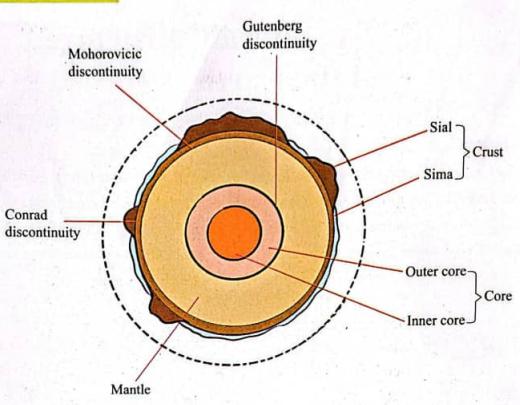
Major Discontinuities
- Conrad discontinuity – separates SIAL from SIMA (discovered by Victor Conrad, 1925).
- Mohorovičić discontinuity (Moho) – boundary between crust and mantle (Andrija Mohorovičić, 1909).
- Gutenberg discontinuity – boundary between mantle and core (Beno Gutenberg, 1912).
Practice Question
Name the three concentric layers of the Earth’s internal structure in order from the surface inwards.
3. The Crust
- Outermost and thinnest layer.
- Thickness: 8–50 km (thinner under oceans, thicker under continents).
- Average density: ≈ 2.7 g/cm³.
- Divided into two sub-layers:
SIAL (Continental Crust)
- Rich in Silica and Aluminium.
- Lighter, forms continents.
SIMA (Oceanic Crust)
- Rich in Silica and Magnesium.
- Denser basaltic rocks that form the ocean floor.
SIAL and SIMA are separated by the Conrad discontinuity. The base of the crust is marked by the Mohorovičić discontinuity.
🌍 Geography Lives
The continental crust under the Himalayas is more than 70 km thick – the thickest crust on Earth – because of the ongoing collision between the Indian and Eurasian plates.
Practice Question
What is the difference between SIAL and SIMA?
4. The Mantle
- Lies between the crust and the core.
- Extends from ≈ 51 km to about 2 900 km depth.
- Density: 3.0–3.4 g/cm³.
- Composed of dense igneous rocks rich in iron, silicon, oxygen, aluminium and magnesium.
Upper Mantle + Crust = Lithosphere
The rigid outer shell of the Earth.
Asthenosphere
A thin, semi-molten (plastic) zone just below the lithosphere that allows tectonic plates to move.
Lower Mantle
Mostly rigid. High temperatures generate convection currents that drive plate tectonics and internal movements.
Practice Question
What is the asthenosphere and why is it important?
5. The Core (Barysphere)
- Innermost part of the Earth, mainly nickel and iron.
- Average density ≈ 10.5 g/cm³ (much higher at the centre).
Outer Core
- ≈ 2 300 km thick, liquid (molten iron-nickel).
- Movement of the molten metal generates electric currents that create Earth’s magnetic field.
- The magnetic field shields the planet from harmful solar radiation.
- Temperature near the mantle–core boundary ≈ 3 700 °C.
Inner Core
- Solid despite temperatures of ≈ 5 500 °C because of immense pressure.
- Diameter ≈ 2 600–2 700 km.
- Density 16–17 g/cm³.
Separated from the mantle by the Gutenberg discontinuity.
🌍 Geography Lives
Without the liquid outer core generating our magnetic field, Earth’s atmosphere would be stripped away by the solar wind – just as happened to Mars billions of years ago.
Practice Question
Why is the inner core solid even though temperatures are extremely high?
6. Role of Earth’s Internal Structure in Rock Formation & the Rock Cycle
Each layer contributes to rock formation:
- Crust – the main stage where igneous, sedimentary and metamorphic rocks form, transform and are exposed.
- Mantle – source of magma that produces igneous rocks; heat and pressure drive metamorphism.
- Core – contributes heat that powers convection and tectonic processes.
Rocks are natural solid materials made of minerals in varying proportions. They differ in colour, texture, density, chemical composition, age, hardness and resistance to erosion.
The rock cycle is the continuous process by which rocks change from one type to another through melting, cooling, weathering, erosion, deposition, compaction, cementation, heat and pressure.
Practice Question
Briefly describe the rock cycle.
7. Igneous Rocks
From Latin ignis = fire. Formed by cooling and solidification of molten material (magma or lava).
- Magma cools inside the crust → intrusive rocks.
- Lava cools on the surface → extrusive rocks.
Intrusive (Plutonic) Igneous Rocks
- Magma cools slowly deep underground → large crystals.
- Examples: granite, gabbro, diorite.
- Also called plutonic rocks; subdivided into hypabyssal (near surface) and truly plutonic (deep).
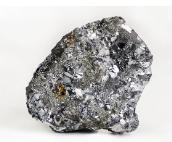
Extrusive (Volcanic) Igneous Rocks
- Lava cools rapidly on the surface → fine-grained or glassy texture.
- Examples: basalt, pumice, rhyolite.
- In Tanzania: Kilimanjaro, Mbeya and Arusha regions.
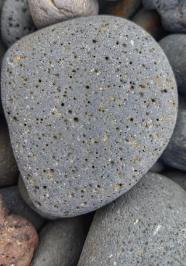
Characteristics of Igneous Rocks
- Hard and crystalline.
- Do not occur in layers and contain no fossils.
- Can be metamorphosed or weathered into sedimentary rocks.
- Often rich in iron and magnesium minerals.
Practice Question
Why do intrusive igneous rocks have larger crystals than extrusive ones?
8. Sedimentary Rocks
Formed from the deposition, compaction and cementation (lithification) of sediments transported by water, wind, ice or waves.
- Usually occur in horizontal layers called strata, separated by bedding planes.
- Often contain fossils.
- Non-crystalline and generally softer than igneous rocks.
Three Types by Mode of Formation
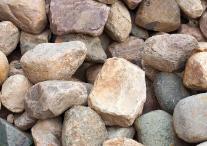
1. Mechanically Formed (Clastic)
- From eroded fragments of pre-existing rocks.
- Examples: sandstone, shale, mudstone, boulder clay, loess, alluvium, moraine.
- Economic use: sandstone for building blocks.
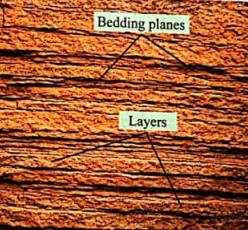
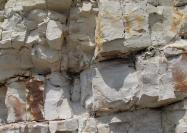
2. Organically Formed
- From remains of plants and animals.
- Examples: limestone, chalk, coral (animal); peat, coal, lignite (plant).
- Uses: chalk in cement and paint; coal as energy source.
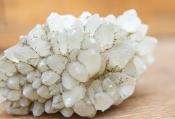
3. Chemically Formed
- Precipitated from solutions.
- Examples: rock salt, gypsum, dolomite, potash, nitrates.
- Uses: fertilisers and building materials.
Characteristics
- Soft and well-jointed.
- Stratified.
- Often fossiliferous.
- Can be metamorphosed.
- Non-crystalline.
Practice Question
Give two examples of organically formed sedimentary rocks – one from plants and one from animals.
9. Metamorphic Rocks
From Greek meta (change) + morph (form). Formed when existing rocks are altered by intense heat and/or pressure, changing their physical and chemical properties without melting.
Types of Metamorphism
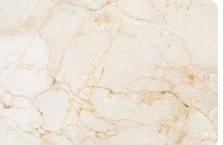
Thermal (Contact) Metamorphism
- Caused mainly by heat from nearby magma or lava.
- Examples: limestone → marble; sandstone → quartzite.
Dynamic (Regional) Metamorphism
- Caused mainly by directed pressure (tectonic forces).
- Examples: shale → schist or slate; clay → slate.

Thermo-Dynamic Metamorphism
- Combined heat and pressure.
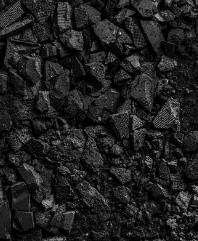
- Example: coal → graphite.
Characteristics
- Harder than most original rocks.
- May show residual layering but are crystalline.
- Can themselves be further metamorphosed or weathered.
Practice Question
How do metamorphic rocks form? Name one example of thermal metamorphism.
10. Internal Forces of the Earth & Earth’s Movements
Internal (endogenic) forces originate inside the Earth from heat, chemical reactions and the movement of rock material. They shape the Earth’s surface by causing vertical and horizontal movements of the crust.
These movements are also called diastrophic or tectonic movements (from Greek tekton = builder). They produce folds, faults, joints, mountains, basins and rift valleys.
Two Main Types of Movement
- Horizontal (lateral) – sideways displacement driven by compressional and tensional forces. Responsible for orogeny (mountain building), faults, block mountains and rift valleys.
- Vertical (radial / epeirogenic) – large-scale up-and-down movements that create plateaus, basins, block mountains and rift valleys.
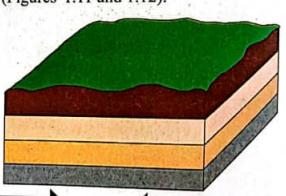
Compressional Forces
Push rocks towards each other → folding and reverse faults.
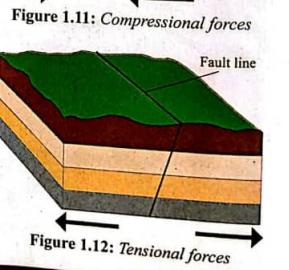
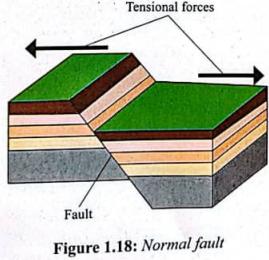
Tensional Forces
Pull rocks apart → normal faults and rift valleys.
Practice Question
What are compressional and tensional forces?
11. Folding
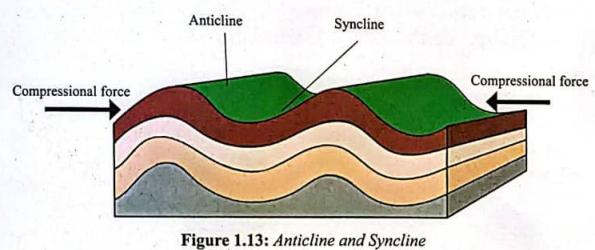
Bending of the Earth’s crust caused by compressional forces. Results in:
- Anticlines – upfolds
- Synclines – downfolds
The sides of a fold are called limbs. Continuous folding produces Fold Mountains (e.g., Andes, Rockies, Himalayas, Alps, Atlas, Drakensberg).
Types of Folds
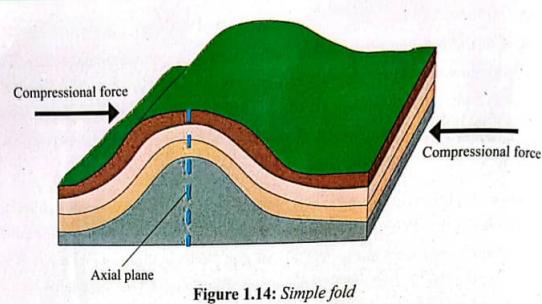
Simple (Symmetrical) Fold
Limbs incline at equal angles; forces equal on both sides.
Asymmetrical Fold
One limb steeper than the other because of unequal force.
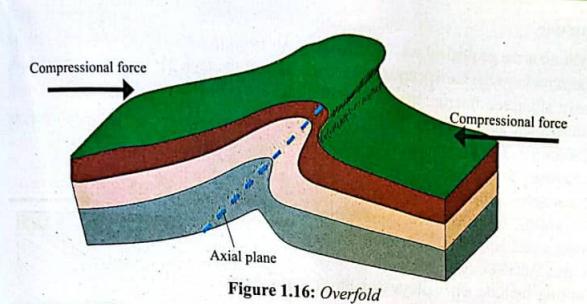
Overfold (Recumbent Fold)
One limb is pushed over the other until limbs are nearly horizontal.
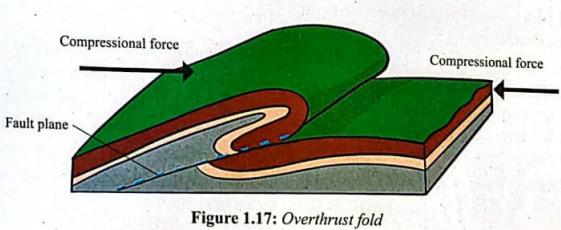
Overthrust Fold
Further compression causes the overfold to fracture; one mass is thrust over the other along a fault plane (nappe).
Practice Question
Describe a simple fold.
12. Faulting
A geological process in which rocks crack and are displaced along a fracture due to tectonic forces (tension, compression or shear).
A fault is the fracture itself along which movement has occurred.
Main Types of Faults
Normal Fault
Caused by tensional forces; the hanging wall moves down relative to the footwall.
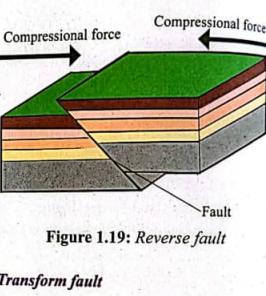
Reverse Fault
Caused by compressional forces; the hanging wall moves up relative to the footwall.
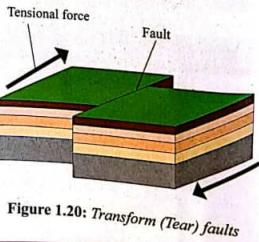
Transform (Tear / Strike-slip) Fault
Blocks slide horizontally past each other; common cause of earthquakes.
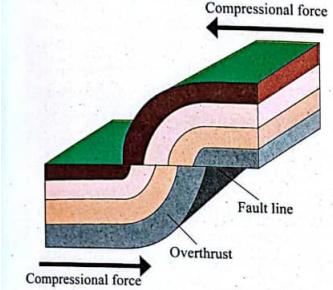
Overthrust Fault
Low-angle reverse fault associated with overthrust folds.
Practice Question
What is faulting? Name two types of faults.
13. Vertical Movements and Resulting Landforms
Also called radial or epeirogenic movements. They cause large-scale uplift or subsidence.
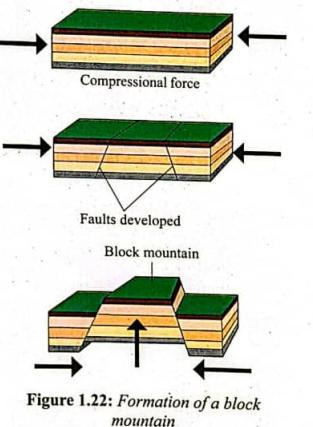
Block Mountain (Horst)
An uplifted block bounded by parallel faults. Can be horizontal (horst) or tilted.
Examples: Usambara, Pare, Uluguru (Tanzania); Ruwenzori (Uganda); Vosges & Black Forest (Europe).
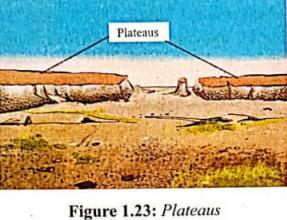
Plateau
Extensive, relatively flat uplifted area with steep edges.
Examples: East African Plateau, Brazilian Plateau.
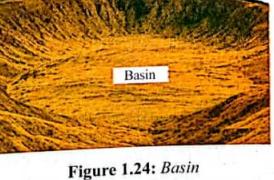
Basin
Large depression formed by down-warping or sinking.
Examples: Lake Victoria basin, Lake Chad, Amazon Basin, Congo Basin.
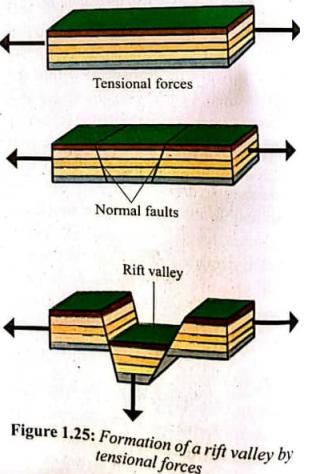
Rift Valley
A long, narrow trough between parallel faults with steep sides.
Formation by Tensional Forces
Sides are pulled apart; the central block (graben) subsides.
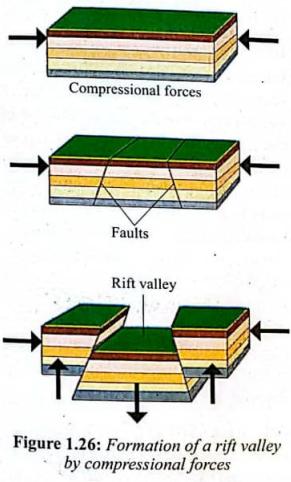
Formation by Compressional Forces
Sides are thrust upward along reverse faults; the centre is relatively down-faulted.
Many East African lakes occupy rift valleys: Tanganyika, Nyasa, Rukwa, Magadi, Naivasha, Turkana, etc.
Practice Question
Explain how a rift valley forms by tension.
14. Vulcanicity
Processes by which molten rock and gases are forced from the Earth’s interior onto or into the crust. Includes both intrusive and extrusive activity.
- Magma = molten rock still underground.
- Lava = molten rock that has reached the surface (after losing most gases).
Causes of Vulcanicity
- High pressure and temperature from the weight of overlying rocks.
- Friction and heat at plate boundaries.
- Infiltration of surface water that turns to steam and increases pressure.
Intrusive Features
Formed when magma cools and solidifies inside the crust.
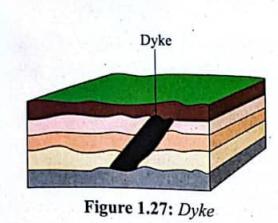
Dyke
Wall-like discordant intrusion that cuts across bedding planes.
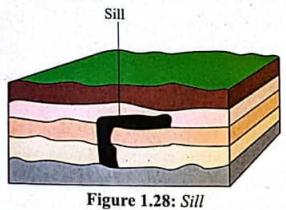
Sill
Horizontal concordant sheet that follows bedding planes.
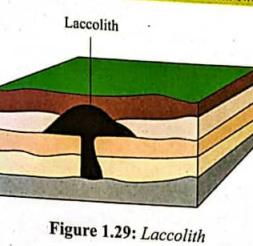
Laccolith
Dome-shaped intrusion that arches the overlying strata.
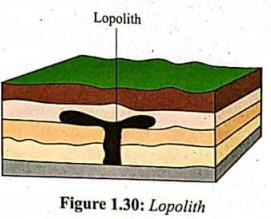
Lopolith
Saucer-shaped, concordant intrusion.
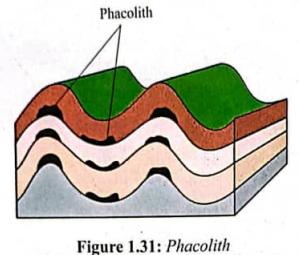
Phacolith
Lens-shaped intrusion occupying the crest of an anticline or trough of a syncline.
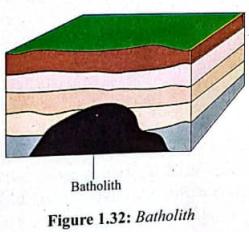
Batholith
Very large, deep-seated irregular mass of coarse-grained igneous rock (often granite). Forms the roots of mountains when exposed.
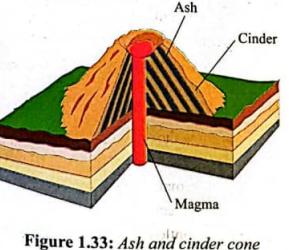
Extrusive Features – Volcanoes
Formed by accumulation of lava, ash and other materials around a vent. The funnel-shaped depression at the top is a crater.
Classification by Activity
- Active – erupts regularly (e.g., Ol Doinyo Lengai, Nyiragongo, Pinatubo).
- Dormant – has not erupted for a long time but shows signs of life (e.g., Kilimanjaro, Meru, Menengai).
- Extinct – no longer active and structure may be heavily eroded (e.g., Mpoli, Mikeno).
Ash and Cinder Cones
Steep cones built of pyroclastic fragments.
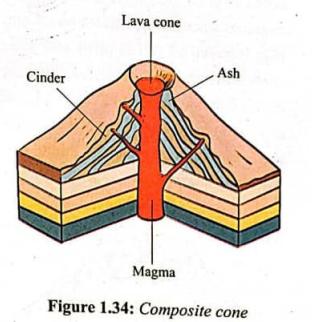
Composite Cone (Stratovolcano)
Large, steep-sided cone of alternating lava and ash layers; often has parasitic cones.
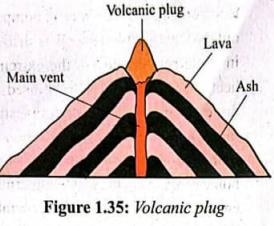
Volcanic Plug (Spine / Dome)
Viscous lava solidifies in the vent, later exposed by erosion.
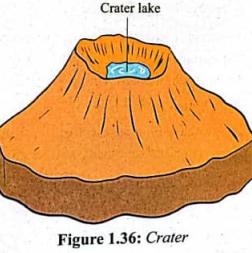
Crater & Crater Lake
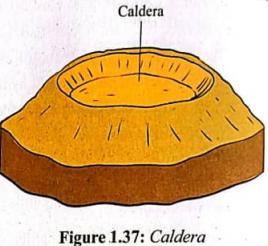
Caldera
Very large depression formed by collapse or explosive removal of the upper part of a volcano.
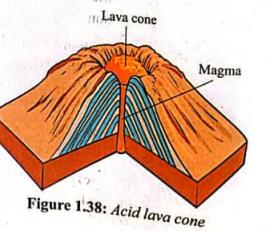
Acid Lava Cone (Cumulo-dome)
Steep, convex dome formed by viscous, silica-rich lava.
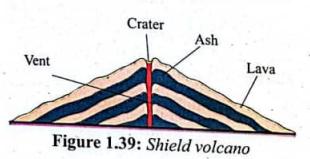
Shield Volcano
Broad, gently sloping cone built of fluid basaltic lava.
Economic Importance of Volcanic Activity
- Fertile volcanic soils for agriculture.
- Precious minerals and metals (gold, silver, etc.).
- Geothermal energy (e.g., Iceland heats ≈ 90 % of homes).
- Useful gases (CO₂ extraction in Tanzania).
- Building materials (basalt, pumice, etc.).
- Tourism (Kilimanjaro, Ngorongoro, Ol Doinyo Lengai).
- Orographic rainfall and river sources for power and irrigation.
Negative Effects
- Lava flows and mudflows destroy life and property.
- Agricultural land can be rendered unusable.
- Poisonous gases (SO₂, CO₂) are hazardous.
Practice Question
Define vulcanicity and give one example of an intrusive feature.
15. Earthquakes
Sudden vibration, shaking or tremor of the Earth’s crust caused by the release of energy from natural (or sometimes human) forces beneath the surface.
- Origin point inside the Earth = focus (hypocentre).
- Point on the surface directly above the focus = epicentre.
- Intensity is measured by a seismograph (seismometer).
Causes
- Isostatic adjustment of the crust.
- Tectonic movements along fault lines (most important).
- Vulcanicity.
- Mass movements (landslides, rockfalls).
- Meteorite impacts.
- Human activities (explosives, mining, large reservoirs).
Effects
- Ground rupture and displacement (horizontal or vertical).
- Tsunamis when the seafloor is displaced (e.g., 2004 Indian Ocean tsunami).
- Destruction of buildings, roads, pipelines and communication lines.
- Fires, landslides and avalanches.
- Loss of life and property (e.g., 2016 Bukoba earthquake in Tanzania).
Safety Measures
Before
- Avoid building high-rise structures in high-risk fault zones.
- Construct earthquake-resistant buildings.
- Prepare emergency plans, first-aid kits, communication plans and trained response teams.
During
- If indoors: Drop, Cover and Hold On (under a sturdy table) or move to open space if safe.
- If outdoors: Move away from buildings, trees and power lines.
- If in a vehicle: Stop safely and stay inside, away from overpasses.
- If trapped: Cover mouth, tap on pipes/walls; shout only as a last resort.
After
- Expect aftershocks.
- Listen to official information.
- Stay away from damaged areas and be alert for tsunamis in coastal zones.
- Check for gas leaks, electrical hazards and structural damage.
🌍 Geography Lives
The 2004 Indian Ocean earthquake released energy equivalent to more than 1 500 times the Hiroshima atomic bomb and generated a tsunami that affected 14 countries, including Tanzania.
Practice Question
What should you do during an earthquake if you are indoors?
16. Summary
This chapter explores the Earth’s internal structure (crust, mantle, core) and how it influences rock formation through the rock cycle (igneous, sedimentary and metamorphic rocks). Internal forces cause movements such as folding and faulting that create mountains, plateaus, basins and rift valleys. Vulcanicity produces both intrusive and extrusive landforms and has both economic benefits and hazards. Earthquakes, mainly caused by tectonic activity, can be destructive, but preparedness and good building practices greatly reduce risk. Understanding these processes is essential for disaster preparedness and environmental management.
Key Definitions
- Crust
- Outermost layer, 8–50 km thick, density ≈ 2.7 g/cm³; divided into SIAL and SIMA.
- Mantle
- Middle layer, ≈ 51–2 900 km depth, density 3.0–3.4 g/cm³; contains the asthenosphere and generates convection currents.
- Core
- Innermost zone: liquid outer core (≈ 2 300 km) and solid inner core (diameter 2 600–2 700 km, ≈ 5 500 °C).
- Rock Cycle
- Continuous process transforming rocks between igneous, sedimentary and metamorphic types.
- Igneous Rocks
- Formed from cooled magma/lava; intrusive (slow cooling) or extrusive (fast cooling).
- Sedimentary Rocks
- Formed from deposited sediments; mechanical, organic or chemical.
- Metamorphic Rocks
- Changed by heat and/or pressure (thermal, dynamic or thermo-dynamic).
- Folding
- Bending of crust by compression producing anticlines and synclines.
- Faulting
- Cracking and displacement along fractures; normal (tension) or reverse (compression).
- Vulcanicity
- Movement of molten materials and gases from the interior to or onto the surface.
- Earthquake
- Sudden shaking of the crust; focus (origin) and epicentre (surface point above focus).
17. End-of-Topic Questions – Correct Answers
- What are the three main layers of the Earth’s internal structure?
Crust, mantle and core. - Explain the difference between SIAL and SIMA in the crust.
SIAL is the lighter continental crust rich in silica and aluminium; SIMA is the denser oceanic crust rich in silica and magnesium. - Why is the inner core solid despite high temperatures?
Immense pressure from the overlying layers prevents the iron-nickel material from melting. - Describe the rock cycle briefly.
It is the continuous process by which rocks change from one type to another (igneous ↔ sedimentary ↔ metamorphic) through melting, cooling, weathering, deposition, compaction, heat and pressure. - What causes igneous rocks to form?
Cooling and solidification of molten magma or lava. - Give two examples of sedimentary rocks and their formation type.
Sandstone – mechanically formed; limestone – organically formed (or gypsum – chemically formed). - How do metamorphic rocks form?
Pre-existing rocks are altered by intense heat and/or pressure, changing their physical and chemical properties. - What are compressional and tensional forces?
Compressional forces push rocks together; tensional forces pull rocks apart. - Describe a simple fold.
A symmetrical fold in which both limbs incline at the same angle because the forces on both sides are equal; the axial plane is vertical. - What is faulting and name two types.
Faulting is the cracking and displacement of rocks along a fracture. Two types: normal fault and reverse fault. - Explain how a rift valley forms by tension.
Tensional forces create parallel normal faults; the central block between them subsides to form a steep-sided graben (rift valley). - Define vulcanicity and give an intrusive feature example.
Vulcanicity is the process of molten materials and gases moving from the Earth’s interior into or onto the crust. Example: dyke (or sill, laccolith, batholith). - What is a composite cone volcano?
A large, steep-sided volcano built of alternating layers of lava and ash (stratovolcano), often with parasitic cones on its flanks. - Name two causes of earthquakes.
Tectonic movements along fault lines; vulcanicity (or isostatic adjustment, mass movements, human activities). - What should you do during an earthquake if indoors?
Drop, cover under a sturdy table or desk, and hold on; or move quickly to open space if it is safe to do so.
Ready for Chapter 2: The External Structure of the Earth?
Continue Form Two Geography in the Click Online Academy app, with all four chapters in your pocket.
Click here to continue learning on our app